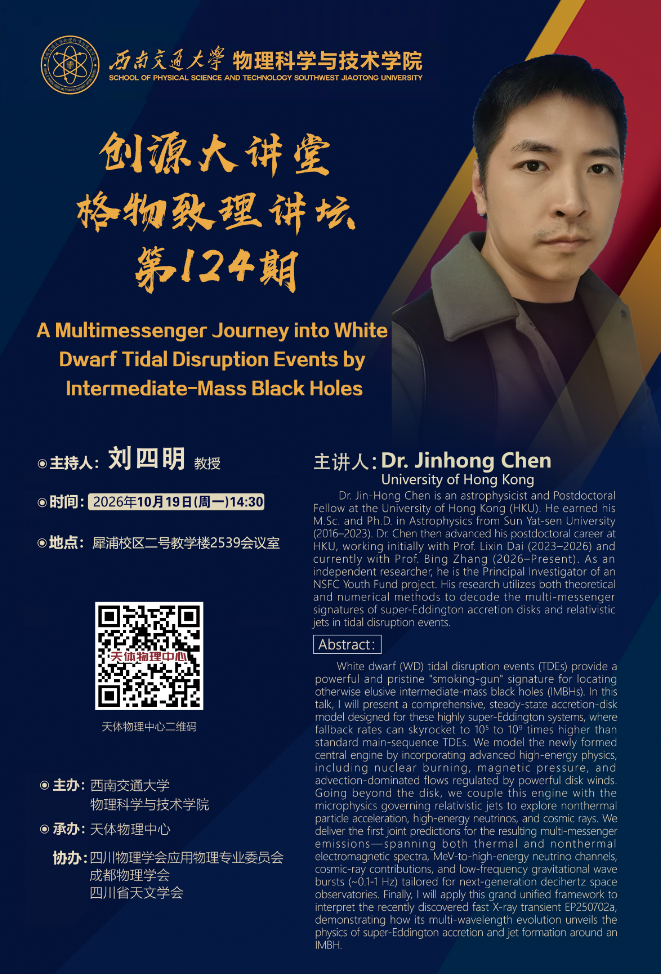
主持人:刘四明教授
时间:2026年10月19日(周一)14:30
地点:犀浦校区二教2539
题目:A Multimessenger Journey into White Dwarf Tidal Disruption Events by Intermediate-Mass Black Holes
主讲人:Dr. Jinhong Chen University of Hong Kong
Dr. Jin-Hong Chen is an astrophysicist and Postdoctoral Fellow at the University of Hong Kong (HKU). He earned his M.Sc. and Ph.D. in Astrophysics from Sun Yat-sen University (2016–2023). Dr. Chen then advanced his postdoctoral career at HKU, working initially with Prof. Lixin Dai (2023–2026) and currently with Prof. Bing Zhang (2026–Present). As an independent researcher, he is the Principal Investigator of an NSFC Youth Fund project. His research utilizes both theoretical and numerical methods to decode the multi-messenger signatures of super-Eddington accretion disks and relativistic jets in tidal disruption events.
Abstract:
White dwarf (WD) tidal disruption events (TDEs) provide a powerful and pristine "smoking-gun" signature for locating otherwise elusive intermediate-mass black holes (IMBHs). In this talk, I will present a comprehensive, steady-state accretion-disk model designed for these highly super-Eddington systems, where fallback rates can skyrocket to 105 to 109 times higher than standard main-sequence TDEs. We model the newly formed central engine by incorporating advanced high-energy physics, including nuclear burning, magnetic pressure, and advection-dominated flows regulated by powerful disk winds. Going beyond the disk, we couple this engine with the microphysics governing relativistic jets to explore nonthermal particle acceleration, high-energy neutrinos, and cosmic rays. We deliver the first joint predictions for the resulting multi-messenger emissions—spanning both thermal and nonthermal electromagnetic spectra, MeV-to-high-energy neutrino channels, cosmic-ray contributions, and low-frequency gravitational wave bursts (~0.1-1 Hz) tailored for next-generation decihertz space observatories. Finally, I will apply this grand unified framework to interpret the recently discovered fast X-ray transient EP250702a, demonstrating how its multi-wavelength evolution unveils the physics of super-Eddington accretion and jet formation around an IMBH.


 川公网安备 51010602000061号